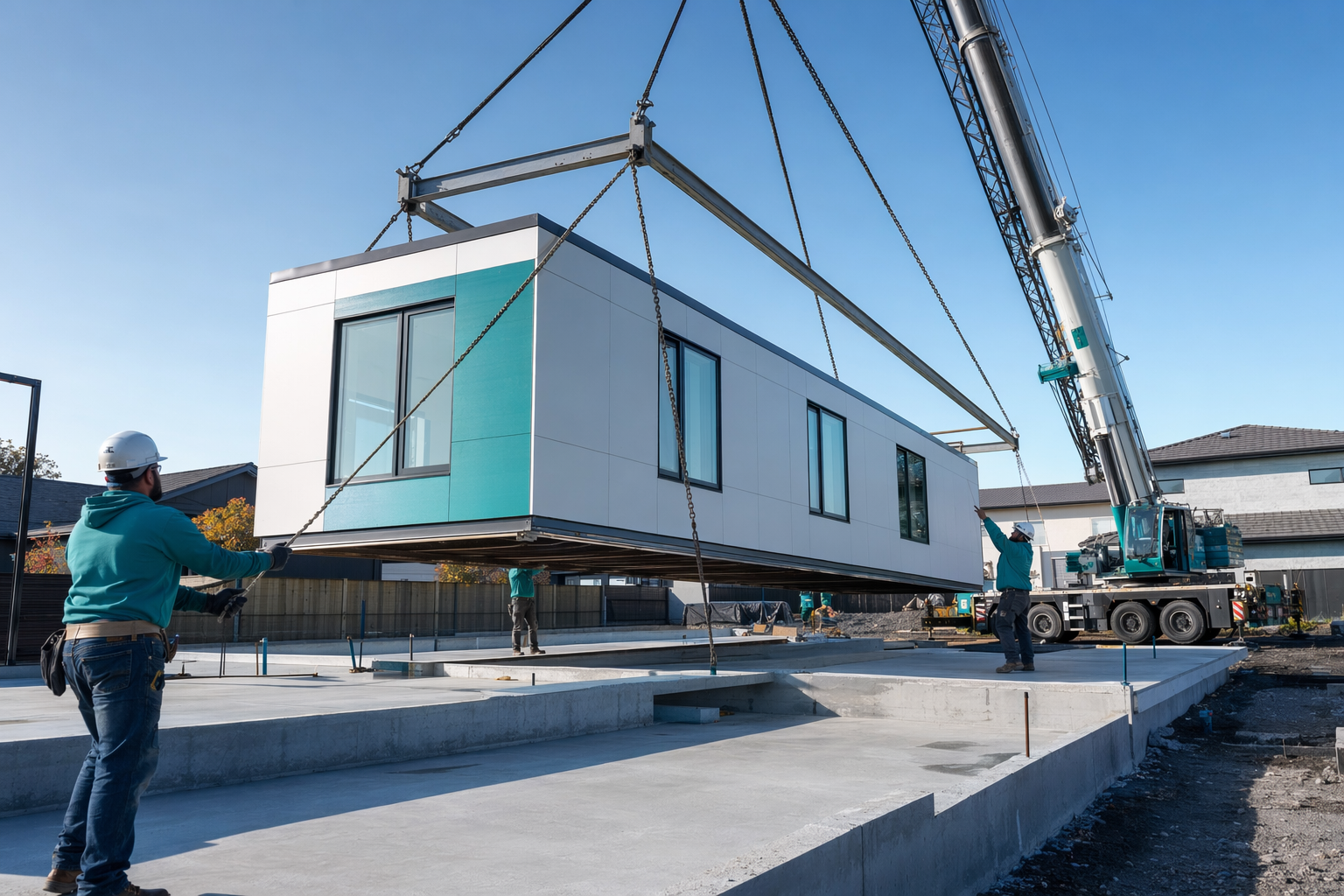
Modular home delivery is the trip from the factory to your land, plus the crane set that places the home on its foundation. It sounds simple, but delivery planning affects road routes, permits, site prep, utility hookups, weather delays, and who is responsible for each step.
What “delivery” means for a modular home
A modular home is built in sections, often called modules, inside a factory. Those modules are then wrapped, loaded onto carriers, and hauled to your homesite. Delivery usually includes transportation, route planning, unloading, and the crane set day.
Delivery is only one part of the job. Your project also needs land work, permits, foundation work, utility connections, and finish work after the modules are set. If you are still comparing home types, see services for modular homes and more guides.
How the delivery process usually works
Most projects follow a basic order:
The builder or transport team reviews the route to your property.
Your site and foundation are prepared before the modules arrive.
The modules are shipped on trailers to the site.
A crane lifts each module onto the foundation.
The crew joins the modules together and finishes the home.
Before delivery day, the site must be ready enough for trucks and a crane to reach it safely. That can mean grading, temporary access, tree trimming, or extra room for turning. Tight roads, steep driveways, low wires, and soft ground can all affect the plan.
After the set, the home still needs finish work. This may include roofing seams, siding touch-up, interior connections, mechanical systems, stairs, decks, and inspections. Ask the builder to list in writing what is included before delivery, on set day, and after set day.
What can affect delivery planning
Several things can change how easy or hard delivery will be:
Distance from the factory to your land
Road limits, such as narrow turns, bridge rules, or weight limits
Local permits for oversized loads or road use
Weather, including wind, rain, snow, or frozen ground
Site access for trucks and the crane
Foundation type, such as slab, crawlspace, or basement
Utility timing for power, water, sewer, or septic
Some homes travel in one or two large modules. Others use more sections. The size and number of modules can affect transport equipment, escort vehicles, crane planning, and set-day coordination.
If you are planning on a small lot or adding a backyard home, delivery can be even more important. An ADU project may need special access planning. Learn more about ADU builder matching.
Who handles delivery, and what to confirm
The company you hire may handle transportation and set coordination directly, or they may use separate transport and crane companies. Responsibilities are not always the same from one project to another. That is why you should ask for a written scope.
Confirm these points in writing:
Who gets transport permits
Who schedules the crane
Who confirms road access and site access
Who is responsible if weather delays the set
What site prep must be finished before delivery
What finish work is included after the modules are placed
Whether utility hookups, porches, steps, and garages are included or separate
ModPath Homes is a free matching service. We are not the builder or transporter. We help you compare options near you, then you choose who to hire. Before you sign, verify the builder's license and insurance yourself, and make sure price, scope, and timeline are written clearly. You can start here: get matched.
Common mistakes to avoid before set day
A common mistake is treating delivery like a simple drop-off. In reality, delivery depends on the whole project being ready. If the foundation is not complete, the access road is too soft, or permits are delayed, the set may need to be moved.
Another mistake is assuming every prefab home is delivered the same way. Modular homes built to the IRC are different from manufactured homes built to the federal HUD code. Panelized homes are different too, because they arrive as wall and roof panels instead of full box-like modules. If you are comparing types, check how it works and browse models.
It also helps to ask early about financing. Some projects use construction-to-permanent loans. Some manufactured homes may use chattel loans, depending on the home, land, and lender rules. Delivery costs and site work should be discussed with the builder and lender together so there are fewer surprises later.
In plain English: Modular home delivery is not just a truck trip. It is a planned part of the whole project, and you should confirm in writing who handles transport, crane work, site access, and finish work.
Common questions
Is modular home delivery included in the home price?
Sometimes, but not always. Some builders include transportation and crane set in their package, and some list them separately. Site work, permits, foundation, utility connections, and finish items may also be separate. Ask for a written breakdown and confirm what is included.
How long does modular home delivery take?
The actual trip and crane set can be short, but the full delivery phase depends on route planning, permits, weather, site readiness, and crew scheduling. There is no single timeline that fits every project. Get the expected schedule in writing from the builder you hire.
Can a modular home be delivered to a rural or hard-to-reach property?
Often yes, but access matters. Narrow roads, steep grades, low branches, soft soil, and limited crane space can create problems. A builder or transport team should review the route and site before set day. Do not assume access will work without a real site review.
What is the difference between modular delivery and manufactured home delivery?
A modular home is usually delivered in factory-built sections and installed on a permanent foundation under state or local code, usually the IRC. A manufactured home is built to the federal HUD code and has its own transport and installation rules. The delivery equipment may look similar, but the codes, approvals, and installation details are different.